Begin with what the text actually says
Herodotus places the phoenix at Heliopolis and openly marks the limits of his evidence: he says he had seen the bird only in pictures. His account describes a rare red-and-gold bird carrying its parent to the sanctuary of the sun. It does not yet give the complete self-burning story familiar from modern retellings.
Ovid later describes a bird that completes a long life, settles among aromatic plants and is followed by a new phoenix. Pliny gathers another version, including competing life spans and an alleged specimen shown in Rome that he reports was regarded as counterfeit. The differences belong to the record; they should not be edited away.
Comparison needs boundaries
Modern English often places the Egyptian Bennu, Chinese fenghuang, Persian simurgh and Slavic Firebird beside the phoenix. Comparison can be useful, but calling each one a regional phoenix can import fire, death and rebirth into traditions that organize their sacred birds around other ideas.
This journal uses phoenix for the Greek and Roman literary tradition, preserves other conventional names, and states when a connection is a later scholarly or artistic comparison rather than an identity asserted by the source culture.
A symbol survives by changing
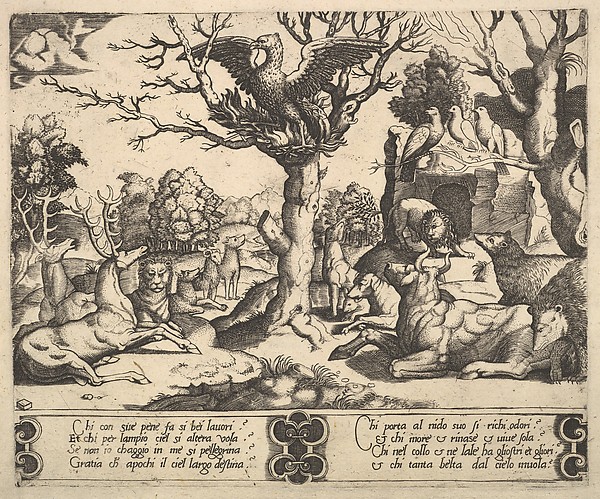
Medieval manuscripts, early modern emblems and contemporary fantasy illustration each selected different parts of the inherited material. Flame became more prominent; renewal became easier to read in a single image; the bird moved from distant marvel to moral, political and personal emblem.
The result is not a straight family tree. It is a layered archive in which writers, makers and viewers repeatedly changed the balance between wonder, evidence and metaphor.
Sources and further reading
- Herodotus, Histories 2.73 — Perseus Digital Library ↗
- Ovid, Metamorphoses, Book 15 — Perseus Digital Library ↗
- Pliny, Natural History, Book 10 — University of Chicago ↗
This article distinguishes source evidence from editorial visual analysis. Last reviewed 30 August 2026.